
Heart Rate Decoupling and How to Use It
During a steady run or a long run, you may have noticed your heart rate slowly climbing even though you don’t feel like you’re working harder. This is a phenomenon we call cardiac drift.
Pace, power, elevation changes and other factors all influence how much heart rate will drift upward during running. We can use these parameters as a performance metric to track progress over the course of the season. When measured this way, we refer to the metric as heart rate decoupling.
What Is Heart Rate Decoupling?
To understand heart rate decoupling, we first need to understand cardiac drift. Cardiac drift is the gradual rise in heart rate during prolonged steady exercise, even when workload remains steady.
To understand why this happens, we need to understand cardiac output. Cardiac output is the total amount of blood your heart pumps per minute. Cardiac output is the product of two variables:
Stroke volume: How much blood your heart can pump/squeeze out on each beat.
Heart rate (HR): How many beats per minute.
Cardiac Output = Stroke Volume × Heart Rate
After sufficient warm up but before significant fatigue, stroke volume is higher and heart rate is lower- relatively speaking. The heart is squeezing hard on each beat to pump more blood per beat, keeping heart rate low.
During steady state exercise, the lungs are pulling oxygen out of the air and into the blood stream, then the heart is pumping this oxygenated blood to the muscles where it’s used as fuel. When we work harder, the muscles need more oxygen, so the heart beats faster.
Why does heart rate go up even when effort stays steady?
There are multiple reasons why heart rate increases even when workload stays constant:
More blood is pushed to the skin to keep body temperature down.
Blood volume decreases due to sweat loss. Lower blood volume means it needs to be pushed around faster to carry the same amount of oxygen to the muscles.
Muscular fatigue reduces mechanical efficiency, requiring more oxygen and blood flow.
As muscles get fatigued, more muscle fibers get recruited. More muscle fibers working requires more oxygen, which means a faster heart rate.
Measuring how this gap between velocity/power and heart rate changes over the course of the run is how we measure heart rate decoupling.
What’s Normal?
Some heart rate decoupling is normal, even in really well-trained athletes. The variable we’re concerned with is how much does heart rate rise in a given run?
Well-trained, durable runners tend to show minimal decoupling when they run steady-state or marathon-pace efforts. They do this by preserving running efficiency late into runs. Because they are well trained, their muscles don’t fatigue as easily, meaning they don’t need to recruit as many muscle fibers which would require more oxygen.
Less efficient or less durable runners show larger decoupling. As fatigue rises, their muscular or biomechanical efficiency decreases resulting in use of less efficient muscle fibers. This change in form or muscle fiber recruitment requires more oxygen and more fat/carbs as fuel to maintain the same pace. This turns into a vicious cycle where energy demands keep increasing even though the pace is constant.
Eventually this cycle reaches a critical point where the runner is burning more fuel than they can eat or drink, and using more oxygen than their heart and lungs can deliver effectively. When this cycle reaches a tipping point, the runner hits the wall or bonks.
How Do We Measure Heart Rate Decoupling?
In real life, pace isn’t constant. Terrain changes, wind shifts, and we naturally increase and decrease our pace throughout the run. So instead of looking at heart rate in isolation, we measure the relationship between heart rate and grade-adjusted velocity or power. We look at the ratio of heart rate to grade-adjusted velocity early in the run vs. later in the run.
As described above, heart rate can rise at a greater rate than velocity. Sometimes we even see velocity decreases while heart rate is still going up. This would indicate a large heart rate decoupling value.
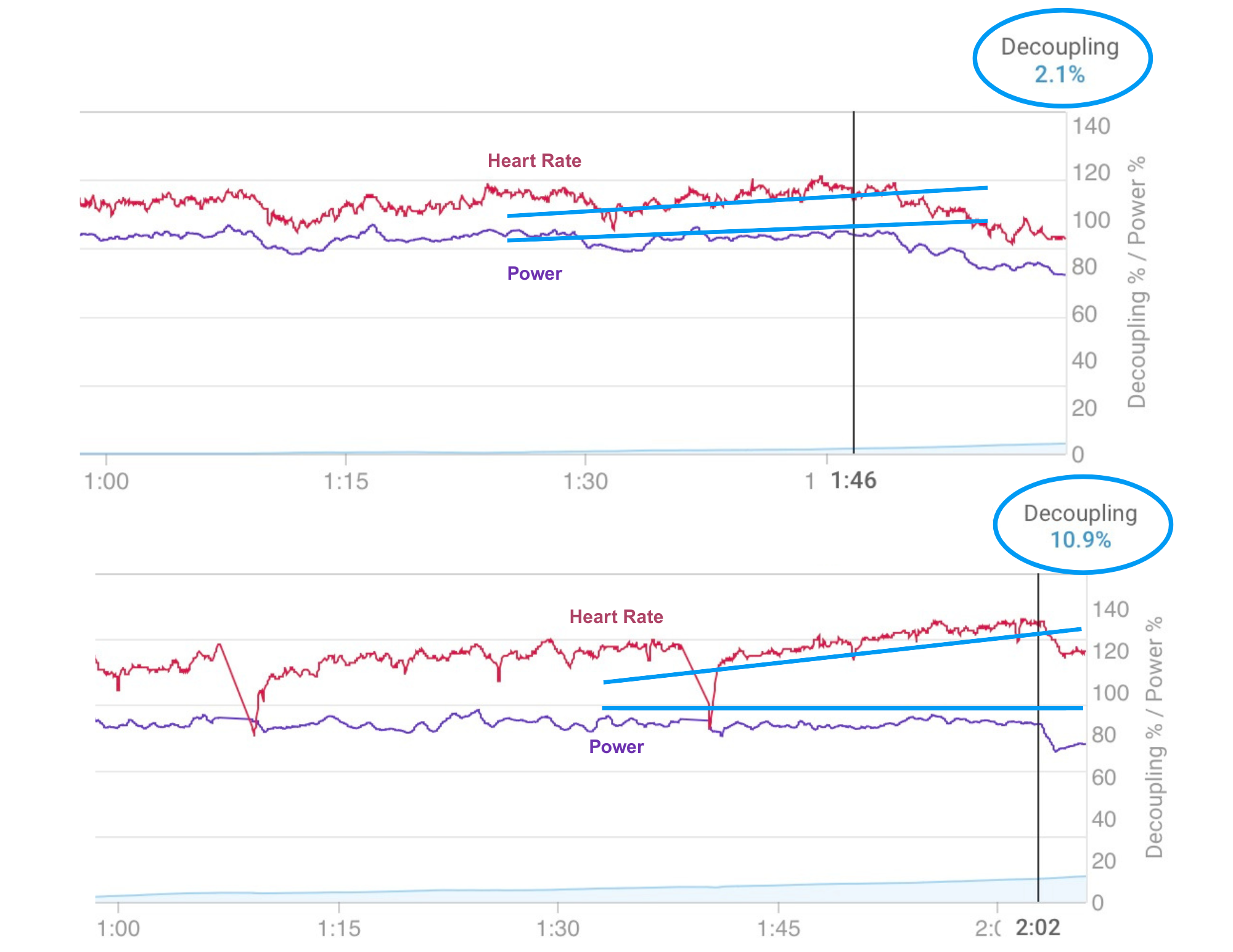
Here is an example comparing two runs: One with low heart rate decoupling, and one with high decoupling. (Graphic created with intervals.icu with data from a Stryd power meter and arm HR monitor)
The run from the top photo has an overall decoupling ratio of 2.1%. You can see how the gap between heart rate and power stays relatively similar the whole way.
The run from the bottom photo has a decoupling ratio of 10.9%. You can see the gap between power and heart rate widening as the run progresses.
How to Calculate Heart Rate Decoupling Yourself
You can calculate heart rate/pace decoupling with basic run data and a spreadsheet. For any of this to matter, you need to make sure your HR monitor is accurate. Wrist-based heart rate monitors are notoriously inaccurate. Your best bet is to wear a chest strap, or an arm hear rate monitor.
I made a spreadsheet where you can plug in your own data here
If you want to learn the process yourself, here is the math involved:
First, divide your run or the workout portion of your run into two equal halves. For each mile or kilometer lap, record:
Grade-adjusted pace (or running power)
Average heart rate
Next, convert pace to grade-adjusted velocity (miles per hour or kilometers per hour). Grade-adjusted pace is measured by almost every smartwatch on the market. Use this value instead of actual pace. Velocity works better mathematically than pace because it scales linearly. This is a simple formula for your spreadsheet:
Miles per hour = 60 / pace in mins/mi
Ex: 7:40 pace. 60 / 7.66 = 7.83 mph
Kilometers would use the same formula:
Kilometers per hour = 60 / pace in mins/km
Ex: 4:45/km - 60 / 4.75 = 12.63 kph
Once you have grade-adjusted velocity, you find the ratio of heart rate and velocity for each half of the run. Decoupling Ratio = Ave Heart rate ÷ Avg velocity. We average the heart rate and velocity for the first half of the run, and compare it to the second half.
Here’s an example:
First half:
HR: 155.2
Grade adjusted velocity: 7.61mph
Ratio HR / grade adjusted velocity: 20.392
Second half
HR: 168
Grade adjusted velocity: 7.692
Ratio HR / grade adjusted velocity: 21.879
First half vs. second half comparison: ((Second half - first half) / (first half)) X 100
21.879 - 20.392 = 1.487
(1.487 / 20.392) X 100 = 7.292%
If you use a power meter, you do this same calculation but plug in power in watts instead of grade-adjusted velocity.
Power Example:
First half:
HR 155.2
Power: 215 watts
Ratio HR / grade adjusted velocity: 0.720
Second half:
HR: 168
Power: 228 watts
Ratio HR / grade adjusted velocity: 0.736
First half vs. second half comparison: ((Second half - first half) / ( first half)) * 100
0.736 - 0.720 = 0.016
(0.16 / 0.72) * 100 = 2.22%
If you did the calculation correctly, you should see a number somewhere between 0% and 20%.
Less than 5% suggests excellent durability. You’re maintaining efficiency well as the run progresses.
Between 5–10% is solid but indicates some room for improvement.
Greater than 10% suggests that pace may be too aggressive for your current fitness, or that durability at that intensity needs work.
Confounding Factors to Watch For
As I mentioned earlier, there are some factors that can skew the results of this calculation.
Temperature: Higher temperatures mean that more blood is pushed to the skin to keep body temperature down, This requires a higher heart rate.
Hydration and heat: In warmer temps, we sweat more. Blood volume decreases due to sweat loss. Lower blood volume means it needs to be pushed around faster to carry the same amount of oxygen to the muscles.
Poor sleep: Poor sleep or recovery means the muscles can fatigue easier, requiring more oxygen and fuel. This will inflate the heart rate or pace decoupling ratio.
Altitude: If you live at sea level and do a workout at altitude, heart rate will be higher because there is less oxygen in the air at altitude.
Caffeine intake: Caffeine will increase heart rate, so you may notice different results on caffeinated runs vs. un-caffeinated runs.
The Key Factors We Care About:
Muscular fatigue: As muscles fatigue, it reduces mechanical efficiency, requiring more oxygen and blood flow.
Muscle Fiber Recruitment: As muscles get fatigued, more muscle fibers get recruited. More muscle fibers working requires more oxygen, which means a faster heart rate.
Through solid training, we can reduce how much the muscles fatigue at your race pace, which means you ultimately get more efficient and reduce the likelihood of bonking or hitting the wall.
Why This Matters:
For marathoners especially, heart rate decoupling is a valuable metric that most runners don’t track, mainly because it’s complicated to calculate. Most training apps don’t calculate it either, but maybe they’ll integrate these calculations eventually.
Intervals.icu does this calculation for you and provides a nice graphic, but you need an accurate power meter to get good data.
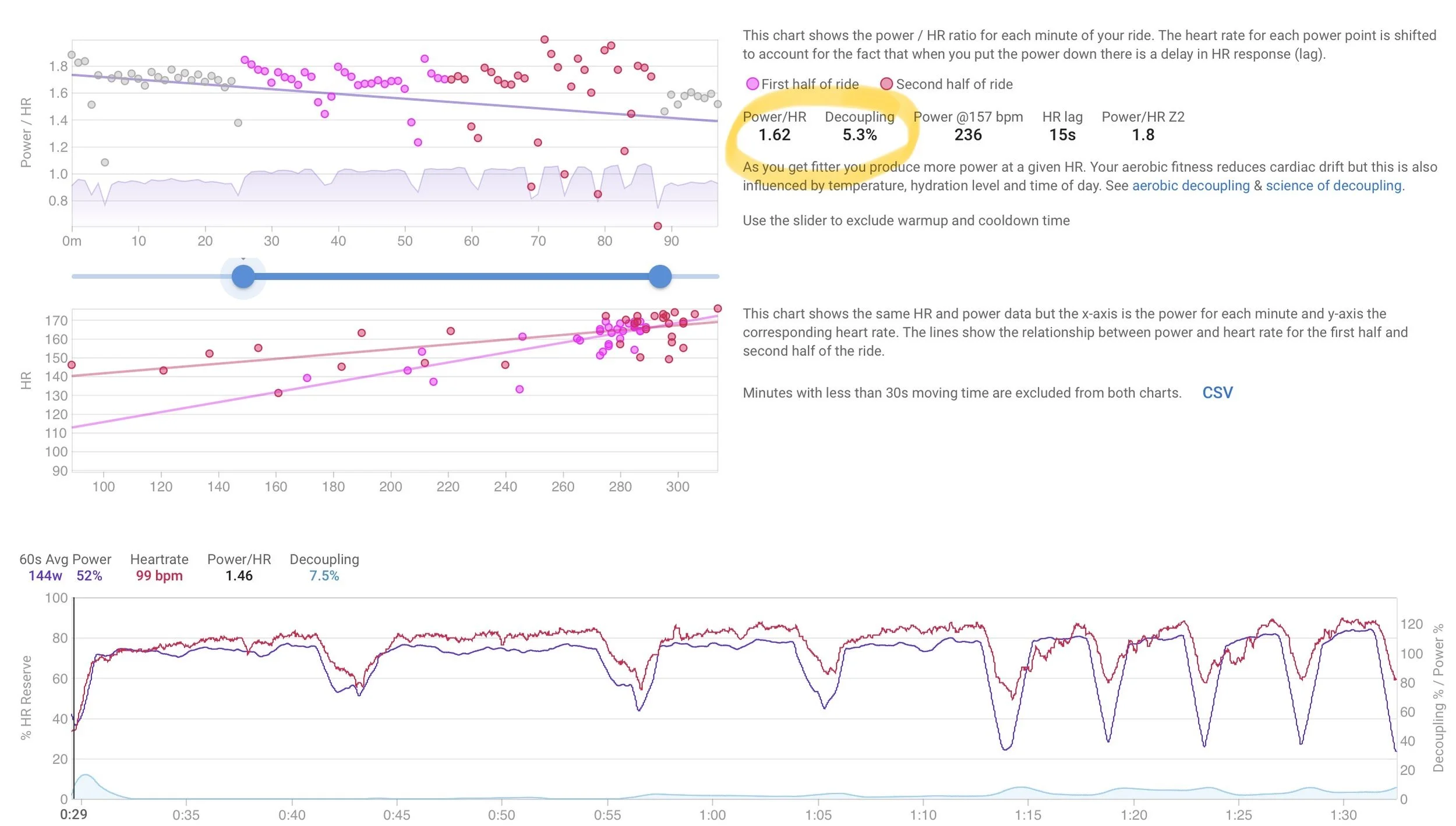
Output on a threshold interval workout from Intervals.icu. Data collected via Stryd power meter and arm-based HR monitor.
Tracking pace/power to heart rate decoupling helps to determine whether your goal marathon pace is appropriate. If you’re seeing 12–15% decoupling during steady runs at “goal pace,” that pace is likely not sustainable for 26.2 miles at the moment. Later in the training cycle we should see this number decrease if everything is going well.
Unlike subjective effort, this provides some objective feedback. It helps give more context to your training. When tracking with myself and my clients, I find that this metric predicts who is more likely to hit the wall during their marathon.
If a runner has a good training cycle and decoupling ratio of 4% at 8:30/mi pace, I can be pretty sure they’ll have a great race at that pace. If a runner has a decoupling ratio of 4% at 8:30 pace, but their goal is 8:00 pace, we’ll have to check their ratio at 8:00 pace. If it’s 12% at 8:00 pace, there’s a higher chance they’ll hit the wall and struggle the last 10k.
It’s not 100% foolproof, but measuring heart rate decoupling is one key metric you can use to increase your chances of a good marathon in your next cycle.
